
Zero-Based Budgeting Explained: Give Every Dollar a Job
With zero-based budgeting, you assign your entire monthly income to categories until the math lands on zero: rent, groceries, fun money, and also savings and sinking funds. No dollar sits around unassigned. That sounds strict, but it's the opposite: once you've decided in advance what your money is for, you don't have to renegotiate every purchase in the moment.
What is zero-based budgeting?
Zero-based budgeting is a planning method: at the start of the month, you take your net income and assign it completely to categories, until what's left unassigned is exactly zero. The formula is simple:
Income − everything assigned = 0
The most important misunderstanding, right up front: zero doesn't mean you spend everything. It means everything has a job. "Savings," "top up emergency fund," and "vacation 2027" are perfectly normal categories: your money isn't gone afterward, it's just assigned. That's exactly what the phrase popularized by the budgeting app YNAB means: give every dollar a job.
The difference from a classic expense tracker: an expense tracker looks backward and logs what happened. Zero-based budgeting plans forward and decides what should happen. The two work best together.
Where does the term come from?
Zero-based budgeting originally comes from 1970s corporate finance: companies were told not to simply carry their budgets forward from last year, but to re-justify every expense in every period from a base of zero. If your search turns up finance articles about corporate budgeting, that's this older, business branch of the idea.
For personal finance, the idea got translated later: instead of "every department re-justifies its costs," it became "every dollar gets reassigned a job every month." US tools like YNAB and EveryDollar made it popular, and it has a close cousin in the old-school envelope system.
How zero-based budgeting works: step by step
An example with $2,800 net income per month:
- 1. Assign fixed costs: Rent $1,050, utilities and internet $120, insurance $95, transit pass $55, subscriptions $35, for $1,355 total. These amounts are set and get their jobs first.
- 2. Sinking funds for predictable expenses: Car insurance, gifts, dental work: expenses that don't come every month, but definitely come. Set up sinking funds for these, say $160 a month.
- 3. Fund your savings goals: $220 into the emergency fund, $110 into a vacation goal, for $330 total.
- 4. Fill the variable categories: Groceries $380, restaurants $130, fun money $160, clothing $85, miscellaneous $110, for $865 total.
- 5. Get to zero: 2,800 − 1,355 − 160 − 330 − 865 = $90. The remaining $90 is still unassigned, so it gets a job too: onto a savings goal, into a category that's running tight, or as a buffer for the unexpected. The plan isn't finished until you hit zero.
During the month, you log every expense to its category. If a category runs dry, you don't quietly keep paying out of thin air; you deliberately move money over: you visibly pull the amount from another category. That keeps the budget honest, and always at zero.
Zero-based budgeting, the envelope system, cash stuffing: how do they connect?
These three terms don't describe three different methods. They describe one principle and its implementations:
- Zero-based budgeting is the principle: assign all your income until you hit zero.
- The envelope system is the classic technique for it: each category gets an envelope with a fixed amount. Empty is empty.
- Cash stuffing is the viral name for exactly that envelope system done with cash (budget binders and savings challenges included).
The most structured rule set built on this foundation is YNAB's four rules: give every dollar a job (assign it all), embrace your true expenses (set aside money monthly for irregular costs), roll with the punches (deliberately shift money around instead of giving up), and age your money (eventually you're living off last month's income instead of paycheck to paycheck). Run the envelope system digitally and follow these four rules, and you're already doing full zero-based budgeting.
Who is zero-based budgeting for?
The method earns its keep when you regularly end the month with less left than you expected, because that kind of leakage is simply impossible once your income is fully assigned. It fits especially well if you're saving toward something specific, paying down debt, or just want to know what your money is actually for.
Its cost is attention: plan once a month, categorize spending as you go. On paper or in a spreadsheet that's tedious: as an app routine it's a few minutes at the start of the month and seconds per entry. If that's still more than you want, the looser 50/30/20 rule is a gentler starting point; many people start there and move to zero-based budgeting once they want more control.
How to do it in GetALife
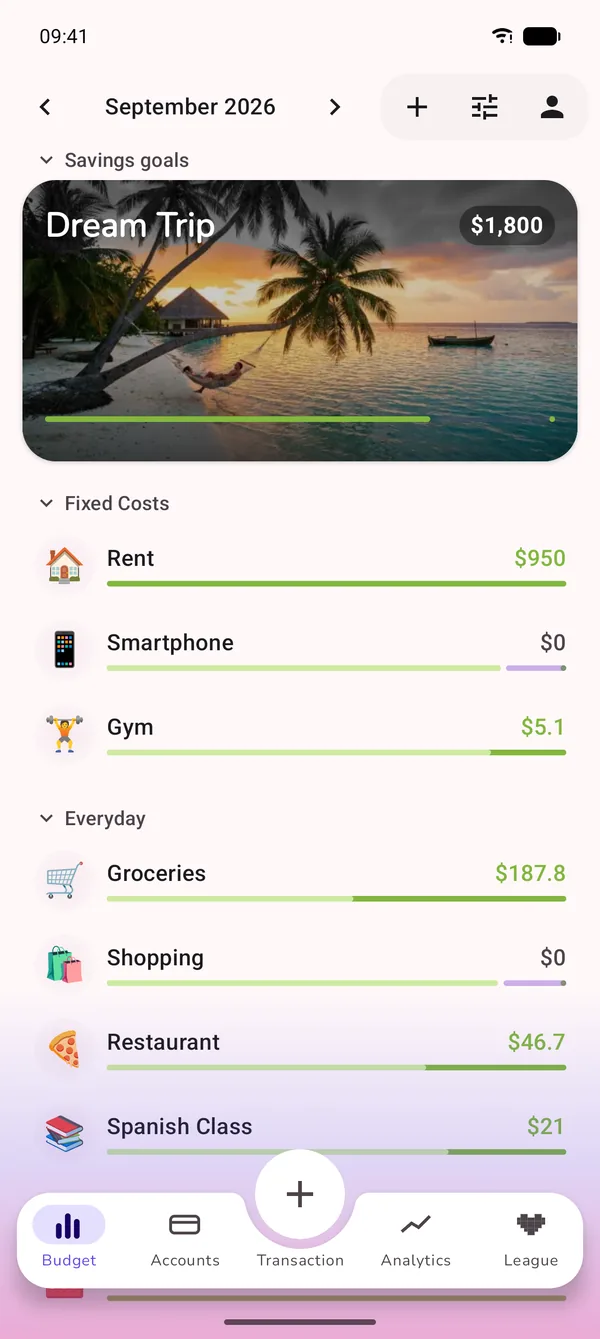
GetALife is built from the ground up for zero-based budgeting:
- "Available" is your zero: The app always shows you how much income still doesn't have a job. You distribute it across your categories until nothing's left, the core of the method as a single number.
- Categories with limits: Fixed costs, needs, wants, savings goals: every category gets its monthly amount and shows how much is left.
- Target amounts for sinking funds: For sinking funds and savings goals you set target amounts and see the progress; the app reminds you when one is falling behind.
- Moving money without chaos: If a category runs dry, you visibly shift money over from another one ("roll with the punches"), without breaking the zero.
- Logging without friction: Log expenses by hand in seconds, or by AI voice input ("groceries 47 dollars"); automatic bank sync is coming soon.
- Sticking with it, rewarded: The league system turns the monthly routine into a game: the best insurance against your budget quietly dying in month three.
Common zero-based budgeting mistakes (and how to avoid them)
- Confusing zero with "spend it all": If you don't plan savings as a category, you're budgeting yourself poor. Savings goals and sinking funds get their jobs first, not last.
- Ignoring irregular expenses: Car insurance in November blows up any budget that only thinks about everyday spending. Plan it as a monthly sinking fund. That's rule two.
- Starting too granular: Thirty categories turn monthly planning into a tax return. Eight to twelve is plenty to start.
- Treating a shift as failure: A category running dry isn't failure: it's information. Deliberately moving money is part of the method; only quietly overspending without a plan ruins it.
- Wanting perfect numbers from day one: Your first month will be off, and that's fine. The amounts get realistic starting month two, once you have real data.
Frequently asked questions
Does zero-based budgeting mean I have to spend all my money?
No, that's the most common misunderstanding. Zero just means every dollar got a job before the month started. Savings, investing, and sinking funds are their own categories and count.
What's the difference from an expense tracker?
An expense tracker looks backward, zero-based budgeting plans forward. The combination is strongest: plan ahead, check behind; a good app does both in one place.
What does "give every dollar a job" mean?
It's the method's shorthand, popularized by YNAB. No dollar sits unassigned: every one gets a job, whether that's rent, a sinking fund, or a savings goal.
Is zero-based budgeting the same as the envelope system?
Zero-based budgeting is the principle, the envelope system is the best-known technique for it. Run digitally, the two merge into categories with limits in a budgeting app.
Conclusion
Zero-based budgeting isn't a deprivation program. It's a decision-making shortcut: you make every money decision once at the start of the month, and after that you just check instead of agonizing. Money quietly leaking away by month's end is simply impossible once your income is fully assigned. And run digitally, the method costs a few minutes a month instead of an evening with a spreadsheet.
Give every dollar a job, starting today
GetALife runs zero-based budgeting with a 7-day free trial: categories, limits, sinking funds, and a league system that keeps you coming back.

 Launching now