
Envelope Budgeting App: The Cash Envelope System, Digital
Envelope budgeting splits your money into labeled envelopes at the start of the month: when an envelope is empty, that category is done until next month. An envelope budgeting app keeps the exact same principle but drops the cash: categories are your envelopes, and an "Available" amount replaces peeking inside. Here's how the system works today.
Where does the envelope system come from?
Envelope budgeting (lately trending again as cash stuffing) dates back to a time when wages were paid in cash. The idea: at the start of the month, you divide your available money into labeled envelopes: rent, groceries, household, fun. Every expense is paid from its envelope, and once an envelope is empty, spending in that category stops.
The method has been passed down through generations and is having a comeback on social media, because it's one of the few budgeting systems anyone understands instantly, with no spreadsheet and no finance degree.
Why envelope budgeting works
Behind the simple system sit two psychological mechanisms:
- The limit is hard, not vague: An account balance is an abstract number that has to cover everything at once. An envelope is a budget you can hold: empty is empty, with nothing to negotiate and no "I'll make up for it next month."
- Loss aversion: Behavioral economics has long observed that losses feel stronger than equally sized gains. Pulling bills out of a thinning envelope makes you feel the expense; tapping a card terminal doesn't. That small sting is exactly what slows down impulse purchases.
There's a practical effect too: the decision happens once at the start of the month, not fifty times in the store. You don't have to re-negotiate every purchase with yourself: the envelope already answered.
Where cash envelopes fail today
As good as the principle is, cash fits modern life poorly:
- Card payments are the default: Rent, utilities, and subscriptions are debited automatically; in stores you tap a card or your phone. Withdrawing cash before every purchase is a detour that kills the routine.
- Online purchases fit in no envelope: You can hand over the "clothing" envelope at a register, not at an online checkout. Yet that's where many impulse buys happen.
- Cash is impractical and risky: Hundreds in envelopes at home are simply gone if they go missing. And envelopes will never show you where your money has been going over the months.
The conclusion isn't to abandon the method: it's to keep the principle and replace the cash.
How digital envelope budgeting works
Digitally, every envelope becomes a category in your budgeting app:
- Create your envelopes: Set up categories like groceries, restaurants, clothing, fun: each category is one envelope.
- Distribute your money: At the start of the month, assign each category a fixed amount. The 50/30/20 rule is a good starting point for the split.
- Pay from the envelope: Every expense is logged to its category: card, phone, or online purchase alike. The category's available amount drops accordingly.
- Check before you buy: Instead of opening an envelope, you glance at the "Available" amount. If there's money left, buy guilt-free. If it reads zero, the purchase waits until next month.
The hard limit of the envelopes now covers card payments and online shopping too, and you get the spending insights cash could never provide on top.
How to do it in GetALife
At its core, GetALife is a digital envelope system:
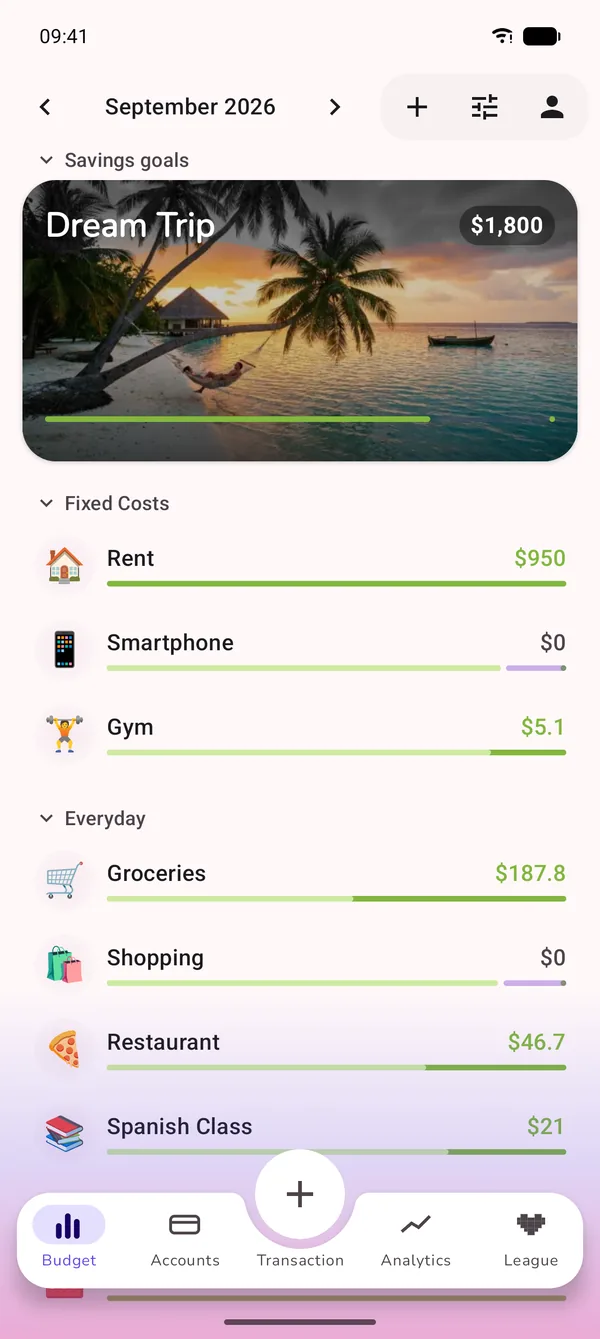
- Categories with limits = envelopes: On the budget screen you create categories in groups like needs, wants, and fixed costs and give each one a monthly limit: your digital stack of envelopes.
- The "Available" amount: Every category shows how much is left this month: the peek into the envelope, right on your phone.
- Every payment type lands in its envelope: Cash, card, or online purchase: you log the expense to its category like in a digital expense tracker. You can log by AI voice input ("groceries 47 dollars") too; automatic bank sync is coming soon, and you can try everything free for 7 days.
- Insights included: The analytics dashboard shows trends and category breakdowns: after a few months you'll see which envelopes are too tight and which too generous.
- Sticking with it, rewarded: The league system keeps you motivated to run your envelopes in month three and beyond: exactly where the cash version usually dies.
Common envelope budgeting mistakes and how to avoid them
- Too many envelopes: Twenty categories turn every entry into a puzzle. Start with eight to twelve and refine later.
- Quietly topping up: If every empty envelope gets an instant refill from another one, you no longer have a limit. Moving money is fine, but deliberately and as the exception, not as a reflex.
- Forgetting irregular costs: Gifts, repairs, annual fees need their own envelopes with a monthly set-aside (so-called sinking funds), otherwise they raid the others.
- Not logging expenses right away: A digital envelope is only honest if every expense is logged promptly. The less friction when logging, the more truthful the system stays.
Frequently asked questions
How many envelopes do I need to start?
Eight to twelve categories are enough. Too many envelopes turn every entry into a sorting task. You can always refine later.
What do I do when an envelope is empty?
Either pause spending in that category until the end of the month, or deliberately and visibly shift money from another envelope. What matters is that it is a decision, not a reflex: quietly topping up undermines the whole system.
Does envelope budgeting work without cash?
Yes, digitally it works even better: categories in a budgeting app are the envelopes, and the "Available" amount is the peek inside. That way card payments and online purchases are covered too, exactly where cash envelopes fail.
What is the difference between envelope budgeting and cash stuffing?
None: cash stuffing is the social-media name for the same method. What is new is the budget binders, the savings challenges, and the community, not the principle.
Conclusion
Envelope budgeting has worked for generations because it turns an abstract account balance into hard, tangible limits. What fails today is the cash, not the principle. Run digitally, you keep the best of the method, cover card payments and online shopping anyway, and get insights and reminders on top.
Start your digital envelopes today
GetALife works offline, comes with a 7-day free trial, and turns envelope budgeting into a game you actually want to win.

 Launching now