
Emergency Fund Calculator: How Much Do You Really Need?
The rule of thumb: keep three to six months of expenses as your emergency fund. If you spend $2,300 a month, that means $6,900 to $13,800. Where you land in that range depends on your job security, your family situation, and whether you own your home: here is the full calculation.
What is an emergency fund, and what is it for?
An emergency fund is a cash reserve for genuine emergencies: the washing machine dies, the car needs a new clutch, the job suddenly disappears. It is not a vacation fund and not a savings goal for wants. It exists purely so that one unexpected hit does not push you into overdraft or debt.
That is why it comes first in any savings plan: before you invest or save for bigger goals, the emergency fund makes sure a single emergency cannot wreck your entire financial setup.
The rule of thumb: 3 to 6 months of expenses
The common recommendation is three to six months of expenses. Important: this is a rule of thumb, not a law of nature. Where you should land within that range depends mainly on three factors:
- Job security: Permanent contract in an in-demand field? Three months is usually enough. Self-employed, on a fixed-term contract, or with fluctuating income? Aim for six months or more.
- Family: If kids or a partner depend on you, you need more buffer than a single household: more people simply means more emergencies can happen at once.
- Homeownership: Owning your home means the furnace, the roof, and the plumbing are your problem. Homeowners should plan at the upper end of the range.
One more thing matters: the rule counts monthly expenses, not monthly income. If you earn $3,600 but spend $2,300, you only need to cover the $2,300.
How to calculate your emergency fund (with an example)
The calculation takes just two steps:
1. Work out your monthly expenses
Add up everything that actually leaves your account each month: rent, utilities, groceries, insurance, transport, subscriptions. Most people underestimate this number: a look at a real expense tracker showing your actual spending over the last few months is far more reliable than guessing.
2. Multiply by your factor
Pick a number between 3 and 6 based on the factors above, then multiply:
- Example: Monthly expenses of $2,300, permanent job, one kid, renting → factor 4.
- Calculation: $2,300 × 4 = $9,200 emergency fund.
That number is your target. It does not have to be reached by tomorrow, but it should be concrete, because "building a reserve someday" is a resolution that never ends.
Where should you keep the money?
Your emergency fund has to do two things: be available at any time and stay out of accidental spending. A separate savings account works well for both, kept apart from your checking account. The separation is the real trick: money you do not see when paying is money you do not spend on impulse.
Brokerage accounts and fixed-term deposits are the wrong place: stocks can be down exactly when you need the cash, and locked deposits are unavailable in an emergency. The emergency fund is not there to earn; it is there to be there.
How to save it up
The most reliable method is automation: set up a standing transfer that moves a fixed amount to your savings account right after payday. That way you save before you can spend, instead of saving whatever happens to be left. How much per month is realistic? Your budget will tell you. At $200 a month you reach the example target in just under four years, at $100 in just under eight, and every intermediate milestone already protects you.
How to do it in GetALife
GetALife takes care of the two hardest parts: an honest starting number and staying on track.
- Real monthly expenses instead of guesses: The expense tracker shows what you actually spent over the past months: the reliable base for your emergency fund calculation. Log expenses by hand or by AI voice input ("groceries 47 dollars"); automatic bank sync is coming soon, and you can try everything free for 7 days.
- A savings goal with visible progress: Create "Emergency fund" as a savings goal with your target amount and watch the progress bar fill with every deposit.
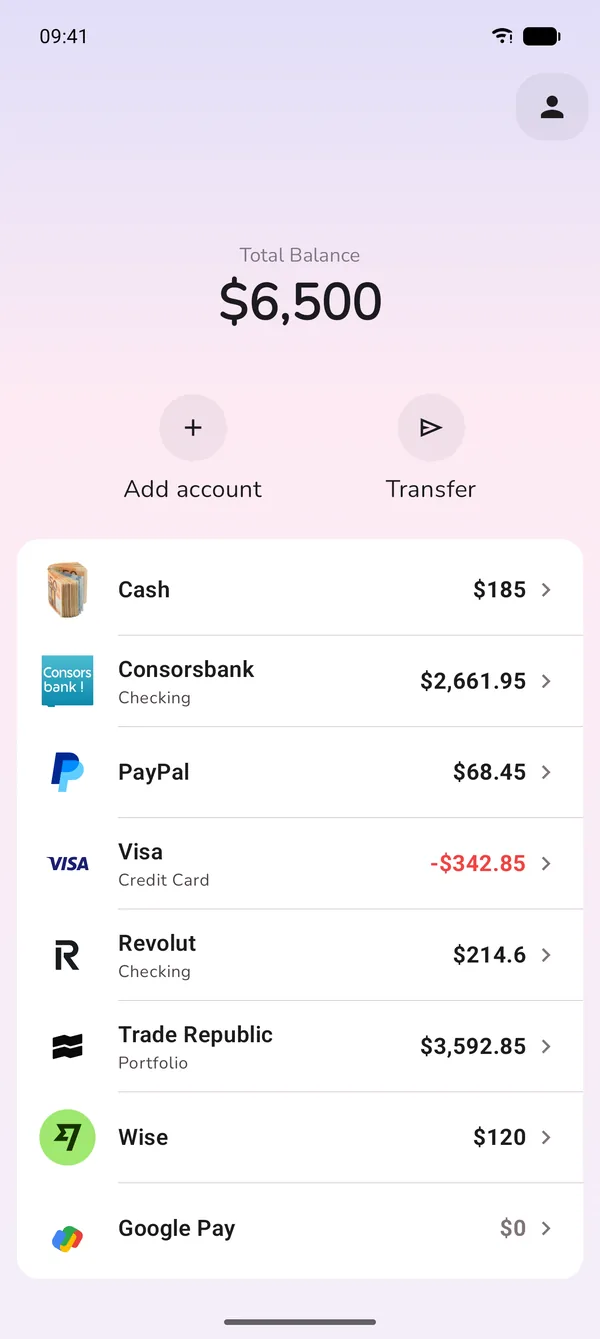
- All accounts in one view: Savings, checking, cash, and credit card sit side by side in the account overview: your emergency fund stays cleanly separated yet always visible.
- Runway as a sanity check: Your financial runway shows how many months your money lasts without income: the perfect cross-check that your fund really covers 3 to 6 months.
Common emergency fund mistakes and how to avoid them
- Keeping it in your checking account: Money sitting between rent and grocery runs melts away. Separate account, clear boundary.
- Calculating with income: The rule of thumb means expenses. Multiplying your salary sets an unnecessarily high target, and makes you give up sooner.
- Investing the emergency fund: Returns are the job of your other savings goals. The emergency fund needs availability, not market upside.
- Paying predictable bills from the emergency fund: Car insurance and holiday gifts are not emergencies: that is what sinking funds are for. Otherwise the buffer is empty when a real emergency hits.
- Not refilling after an emergency: Spending it is exactly what it is for, but afterwards, the standing transfer goes back on until the target is rebuilt.
Frequently asked questions
How big should my emergency fund be?
Three to six months of expenses. On $2,300 in monthly expenses, that means $6,900 to $13,800. Where you land in that range depends on your job security, family situation, and housing situation.
Where should I keep my emergency fund?
In a savings account: separate from your checking account, available any day, earning interest. Not in a brokerage account: an emergency fund needs availability, not upside.
Do I calculate with income or expenses?
With expenses. If you earn $3,600 but spend $2,300, you only need to cover the $2,300. Calculating with income sets the target unnecessarily high.
What counts as an emergency, and what does not?
A broken washing machine, a car repair, job loss: yes. Car insurance, gifts, vacation: no. Those are predictable and belong in their own sinking funds, otherwise the buffer is empty when a real emergency hits.
Bottom line
Calculating your emergency fund takes five minutes: find your real monthly expenses, multiply by a factor between 3 and 6, done. The real work is saving it up, and that becomes easy once you automate it and can see your progress. A concrete target number plus an automatic transfer beats every good intention.
Build your emergency fund with GetALife
GetALife shows your real monthly expenses, tracks your savings goal with visual progress, and your runway tells you how long your cushion actually lasts.

 Launching now