
Cash Stuffing: How the Viral Money Trend Works (and Its Digital Upgrade)
Millions of views for videos of cash getting sorted into colorful envelopes: cash stuffing is the savings trend of the last few years. Behind it isn't a new invention: it's the classic envelope system with a new aesthetic and a massive community. Here's how the trend works, why it really helps you save, and how to run it without cash's downsides.
What is cash stuffing?
Cash stuffing means: at the start of the month, you withdraw your budget as cash and split it across labeled envelopes or the pockets of a budget binder: groceries, gas, fun money, beauty. Every expense gets paid out of its envelope. Once it's empty, that category is done for the month.
If that sounds familiar, it's because it's exactly the envelope system that older generations practiced with cash pay envelopes. Three things are new about the trend: the aesthetic (pastel binders with zip pouches, lovingly decorated category cards), the community (under #cashstuffing, people show each other their monthly routine), and the game elements (savings challenges like the 52-week challenge, "unstuffing" videos at month's end where leftover cash gets counted and reassigned).
Technically speaking, cash stuffing is an implementation of zero-based budgeting: your whole monthly budget gets fully assigned to jobs up front.
How cash stuffing works: step by step
- 1. Set your budget: After fixed costs (which keep coming out of your account as usual; rent doesn't belong in an envelope), figure out what's left for variable spending. The 50/30/20 rule is a good starting point.
- 2. Pick your categories: Six to ten envelopes is plenty: typical ones are groceries, gas, restaurants, fun money, clothing, gifts.
- 3. Add sinking-fund envelopes: For expenses that don't come every month but definitely come (car insurance, holidays, repairs), the community runs so-called sinking funds: envelopes that grow over months until the bill is due.
- 4. Withdraw and distribute cash: At the start of the month (or with every paycheck), the cash gets withdrawn and "stuffed" into the envelopes.
- 5. Pay only from the envelope: Every expense comes out of its envelope. Empty means empty. Refilling from another envelope only happens deliberately, not by default.
- 6. Unstuffing at month's end: Whatever's left gets counted and moves into a savings goal or the next month, the most visible and most popular moment of the method.
Why cash stuffing actually works
The trend is more than pretty envelopes. It taps into two solid psychological effects:
- Hard limits instead of a vague balance: An account balance covers everything at once and feels negotiable. An envelope is a budget you can hold. Empty is empty.
- Paying hurts again: Losses feel stronger than equally sized gains. Pulling bills out of a thinning envelope triggers exactly that feeling. A card terminal doesn't. That small sting slows down impulse purchases.
On top of that comes the community effect: people who share their monthly routine and join challenges stick with it longer. Motivation isn't a nice-to-have in budgeting: it's the factor that most attempts actually fail on.
The downsides of the cash version
As good as the principle is, the cash implementation has real problems:
- Security risk: A few hundred dollars in envelopes at home is usually only insured up to a small fraction in case of theft or loss. And cash in a binder earns zero interest.
- Online purchases fit in no envelope: Subscriptions, online shopping, card payments at a restaurant: a growing share of spending happens outside the envelopes, and that's exactly where a lot of impulse buying happens.
- The withdrawal detour: Getting the right cash denominations together every month is work, and plenty of ATMs don't hand out small bills.
- No analytics: Envelopes show you what's left, but not where your money's actually been going over the months. Trends and patterns stay invisible.
Cash stuffing, digitally: same effect, no cash
The good news: what makes cash stuffing work (fixed amounts per category, a hard limit, a visible remainder) works without cash too. Digitally, every envelope becomes a category in your budgeting app: you assign your budget at the start of the month, every expense (cash, card, or online) gets logged to its category, and the "available" amount is your peek inside the envelope. The hard limit stays, but online purchases are suddenly covered, the security risk disappears, and you get analytics built in. For the full picture, see our guide to the digital envelope system.
How to do it in GetALife
GetALife brings the cash-stuffing logic to your phone, including the part that makes the trend work so well in the first place: the game feel.
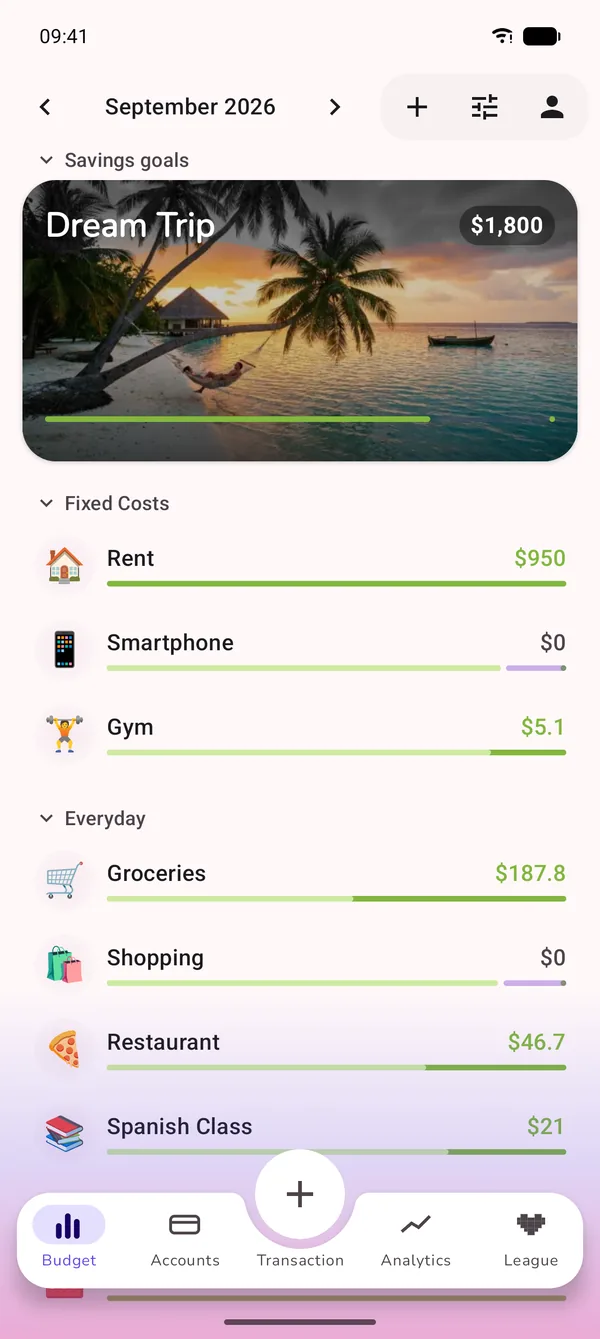
- Categories are your envelopes: You set up categories with monthly limits and assign your budget at the start of the month (stuffing without an ATM).
- The "available" amount: Before every purchase, you see in seconds what's left in the envelope, even standing at the checkout.
- Sinking funds included: Sinking-fund categories with a target amount grow month by month, like the holiday envelope in the binder, just earning interest in your account instead of sitting in a drawer.
- Unstuffing built in: Whatever's left at month's end, you visibly move to a savings goal or into next month.
- Challenges and leagues: The league system does what the TikTok community does: it turns sticking with it into a game, with divisions, score, and a leaderboard.
- Logging in seconds: By hand or by AI voice input ("drugstore 23 dollars"). Automatic bank sync is coming soon, and you can try everything free for 7 days.
Common cash stuffing mistakes (and how to avoid them)
- Putting fixed costs into envelopes: Rent and utilities go out by bank transfer; they don't belong in envelopes, they get deducted from the budget up front. Only variable spending gets stuffed.
- Too many envelopes: Fifteen categories look pretty in a binder, but turn every purchase into a sorting task. Six to ten is plenty.
- Ignoring the online gap: If you only budget cash, you're only budgeting half of reality. Either track online spending separately, or go fully digital.
- Refilling on reflex: An empty envelope that gets quietly topped up right away isn't a limit anymore. Moving money is fine, but deliberately and visibly.
- Stuffing just for the camera: The prettiest binder aesthetic doesn't help if the amounts are unrealistic. Honest, unglamorous numbers beat a perfect video.
Frequently asked questions
What's the difference between cash stuffing and the envelope system?
None. Cash stuffing is the social media name for the classic envelope system. What's new is the aesthetic, the community, and the challenges, not the principle.
Is cash stuffing just a TikTok hype?
The hype is new, the method isn't. Hard category limits and the felt pain of paying slow down impulse purchases. That worked before TikTok and it works after. The weaknesses sit in the cash implementation, not the principle.
How much cash am I allowed to keep at home?
As much as you want, but renters and homeowners insurance typically only reimburses cash up to a fairly low policy limit. If you're storing months of budget in a drawer, you carry that risk yourself. One more reason to go digital.
Does cash stuffing work without cash?
Yes: categories with fixed limits in a budgeting app are the same envelopes, except card payments and online purchases get tracked too, and nothing can get stolen.
Conclusion
Cash stuffing gave an old, proven method a new audience, and rightly so: fixed envelopes per category are one of the most effective budgeting systems there is. The cash itself isn't the active ingredient, though; it's just the packaging. Keep the principle and run the envelopes digitally, and you get the trend's effect without its risks, plus analytics no binder in the world can give you.
Start your cash stuffing (no ATM required)
GetALife turns the savings trend into a system: digital envelopes, sinking funds with a target, and a league system that keeps you coming back. 7-day free trial on Android.

 Launching now