
YNAB Alternative: The Same Method for Less
YNAB is one of the best budgeting apps ever built, and at $14.99 a month or $109 a year after the 34-day trial, one of the most expensive. If you love zero-based budgeting but not the price tag, you have options: GetALife gives you the same envelope principle for less per year, with a 7-day free trial and motivation built in.
Why people look for a YNAB alternative
YNAB (You Need A Budget) has taught a whole generation to plan their money instead of hoping for the best. Still, two complaints come up again and again:
- The price: After 34 days of trial, YNAB costs $14.99 per month or $109 per year. For an app whose whole point is helping you spend less, that is a lot of money, and the most common reason people search for "YNAB too expensive".
- You pay for everything or nothing: There is no free tier. If you stop paying, you lose the tool, even if all you need is basic category budgeting.
Neither complaint means the method is wrong. It means the pricing model does not fit everyone.
What YNAB gets right (and what you should keep)
Let's be fair: YNAB earned its reputation. The method behind it, zero-based budgeting, genuinely works. The idea: you give every dollar you actually own a job before you spend it. Rent, groceries, savings, fun: nothing is left floating around unassigned. That is why YNAB users know exactly where their money went, while everyone else wonders at the end of the month.
So if you leave YNAB, do not leave the method. Switch the tool, keep the principle. The same idea has existed for decades as the cash envelope system, just digital now. If the concept is new to you, start with our guide to envelope budgeting with an app.
The four YNAB rules (and how to keep them without YNAB)
YNAB packages its method into four rules. They are the heart of what any good alternative has to carry over. Here is each rule, and how you run it in GetALife:
Rule 1: Give every dollar a job
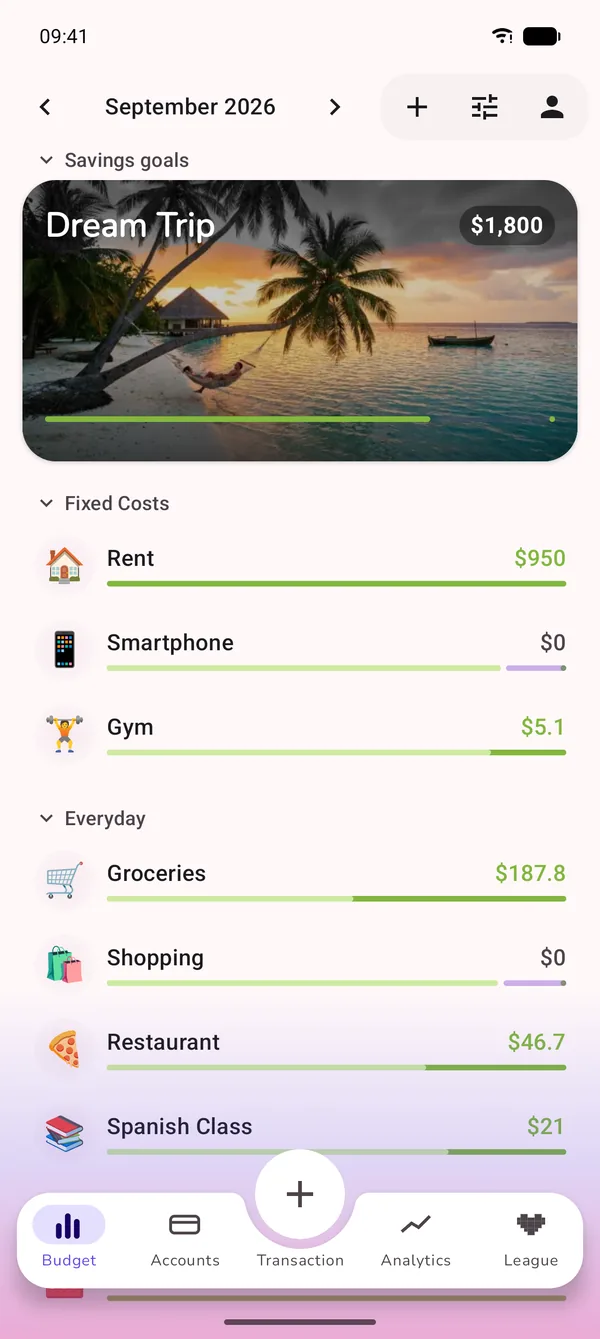
Assign all the money you actually own to a task (rent, groceries, savings goals) until nothing is left unassigned. In GetALife that is the "available" amount: you distribute it across your categories at the start of the month until it hits zero.
Rule 2: Embrace your true expenses
Car insurance, gifts, and repairs don't come monthly, but they come for sure, so you save for them monthly instead of getting shocked in November. That is the sinking funds principle; in GetALife these are categories with a target amount.
Rule 3: Roll with the punches
An empty category is not failure: you deliberately move money over from another one, and the budget stays honest. In GetALife you shift amounts between categories visibly: the budget reflects reality, not the wish list from the first of the month.
Rule 4: Age your money
The long-term goal: eventually live on last month's money instead of paycheck to paycheck. Run the first three rules for a few months and this happens on its own; in GetALife you watch the progress through your financial runway.
What a good YNAB alternative needs
- The same method: Categories with limits and an "available" amount you actually assign. A read-only spending report is not a budget.
- A fair price: An app whose whole point is helping you save shouldn't be one of your biggest subscriptions. A trial to test it and a price well below $109 a year matter more than a free tier.
- Low friction: Entering an expense must be faster than forgetting it. The best budget is the one you still update in week six.
- Built-in motivation: Most budgets do not fail on math, they fail on consistency. An app that rewards you for sticking with it fixes the real problem.
How to do it in GetALife
GetALife is built around exactly this combination, the YNAB principle for less:
- The full method, fairly priced: Create categories, set limits, assign every dollar a job: the yearly plan costs considerably less than YNAB, and you can try everything free for 7 days. The "available" amount always shows what is left to assign. New to budgeting? Here is how to make a budget step by step.
- Voice input: Say "groceries 47 dollars" and the AI creates the transaction with amount, merchant, and category. See how voice expense tracking works.
- Automatic bank sync via finAPI (coming soon): If you would rather not type at all, your transactions will be imported automatically (built for German and European banks).
- League system: GetALife's unique twist: consistent budgeting moves you up through divisions, from Grey all the way to Orange. The motivation piece classic budget apps are missing.
- Financial runway: The app shows how many months your money would last without income; read more in the financial runway guide.
GetALife vs. YNAB vs. classic trackers
Most low-cost alternatives to YNAB are classic expense trackers: they record what you spent, but they do not plan anything. Here is how the three approaches compare:
| Feature | GetALife | YNAB | Classic trackers |
|---|---|---|---|
| Yearly price | ✓ 7-day free trial | ✗ 34-day trial, then $109/year | ✓ usually free |
| Envelope / zero-based budgeting | ✓ | ✓ | ✗ recording only, no planning |
| Voice input | ✓ | ✗ | ✗ |
| Gamification | ✓ league system | ✗ | ✗ |
| Financial runway | ✓ | ✗ | ✗ |
Prices as stated by the providers, as of August 2026.
Common mistakes when switching from YNAB (and how to avoid them)
- Trying to migrate your whole history: Importing years of old transactions costs hours and changes nothing. Start fresh with your current account balances: a budget lives in the present.
- Dropping the method with the app: Switching tools is not a reason to stop giving every dollar a job. Keep the principle, change the software.
- Carrying over too many categories: Thirty finely sliced YNAB categories turn every entry into a decision. Eight to twelve are plenty to start.
- Running both apps for months: Maintaining two budgets doubles the work and halves the motivation. Give the new app one full month, then decide.
Frequently asked questions
Is there a cheaper alternative to YNAB?
Yes. GetALife runs the same zero-based budgeting method (categories with limits and an available amount you actually assign) for less per year than YNAB, with a 7-day free trial to try it first.
What does YNAB cost?
After the 34-day trial, $14.99 a month or $109 a year (as of August 2026).
How does GetALife compare to YNAB?
GetALife runs the same method (categories with limits and an available amount that's actually assigned) plus a league system that turns budgeting into a game. The yearly plan costs considerably less than YNAB, and you can try everything free for 7 days.
What should I keep in mind when switching from YNAB?
Bring the method, not your old data: start with a fresh monthly budget instead of importing years of history. What matters more than old numbers is that the routine (assigning every dollar a job) continues without interruption.
Bottom line
If you are deep in the YNAB workflow and the price does not bother you, staying is a perfectly good choice: it is a mature, excellent app. But if $109 a year feels wrong for a tool that is supposed to save you money, GetALife runs the same method that matters (zero-based envelope budgeting) for less per year, with a 7-day free trial to try it first, and adds the one thing YNAB never had: a league system that makes sticking to your budget feel like a game you want to win.
Try the YNAB Alternative Free for 7 Days
GetALife brings envelope budgeting to your phone for considerably less than YNAB, with voice input, a league system, and a 7-day free trial to try it first.

 Launching now